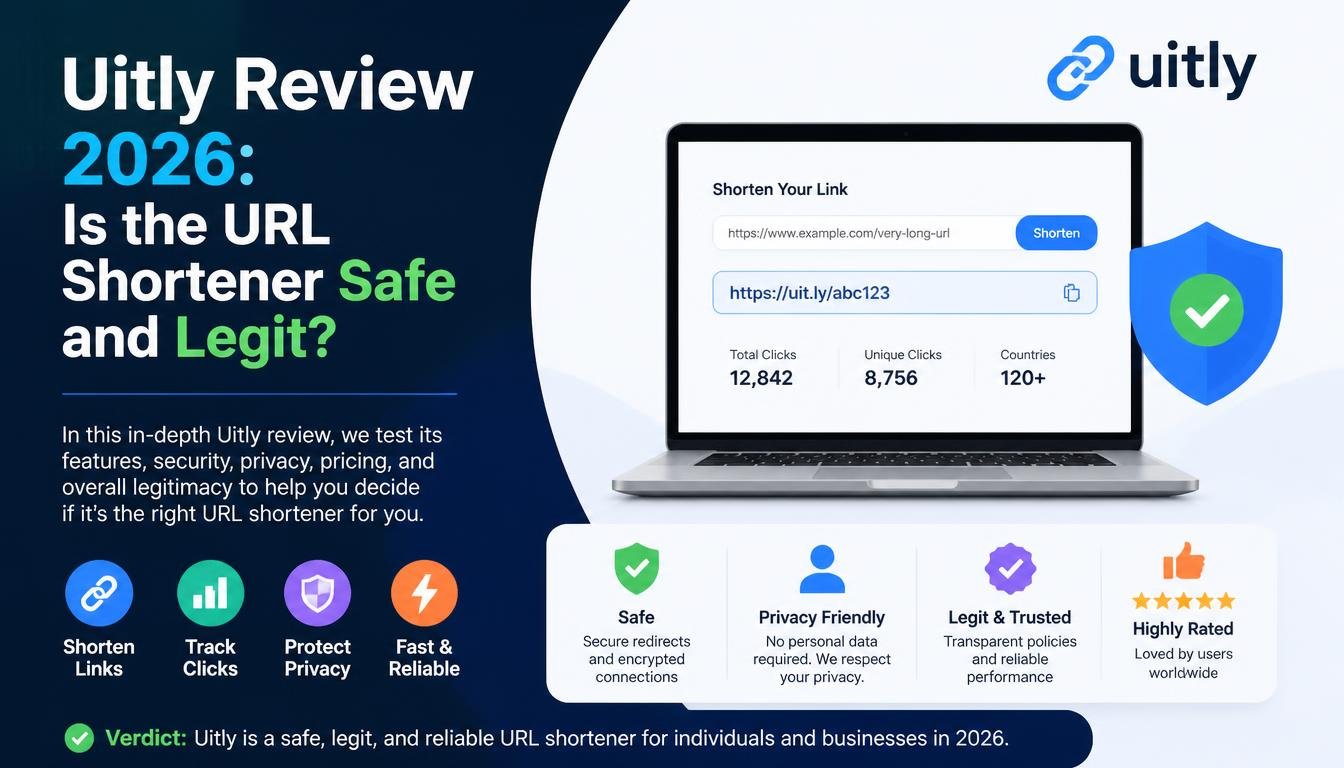
Uitly Review 2026: Is the URL Shortener Safe and Legit?
Evaluating whether a digital tool remains secure is a priority for any professional managing online traffic, which is why a thorough Uitly Review 2026: Is the URL Shortener Safe and Legit is essential. URL shorteners are common, but their safety varies based on how they handle redirects and user data. This article provides a clear verdict on the platform’s current standing, its security protocols, and how it compares to industry standards.
By examining the technical infrastructure and user reports, you will gain the clarity needed to decide if this service fits your workflow. Understanding the risks and benefits of such tools is the first step toward maintaining a secure online presence.
To answer the core question of this Uitly Review 2026: Is the URL Shortener Safe and Legit?, the platform is generally considered a legitimate service that provides standard redirection functionality. It functions as a functional tool for condensing long web addresses into manageable formats for social media and marketing campaigns.
While it does not carry the same brand recognition as industry giants like Bitly, it operates within the expected parameters of a public-facing redirection service. Users should exercise standard caution, as with any third-party link management tool, by avoiding the use of shortened links for sensitive financial or personal data.
Understanding the Mechanics of URL Shorteners
At its simplest level, a URL shortener acts as a digital bridge between a short, aesthetic link and a long, complex destination address. When a user clicks a shortened link, the server hosting the service performs a 301 or 302 redirect to the target page.
This process happens in milliseconds and is designed to be invisible to the end user. The core value lies in the ability to track clicks and clean up messy URLs that would otherwise break formatting in emails or social media posts.
Most services in this space generate revenue through premium subscriptions or by displaying interstitial advertisements before the final page loads. Uitly follows a model that balances accessibility for casual users with premium options for power users.
Because the service relies on server-side redirects, the security of the link depends entirely on the integrity of the host domain. If the host domain is compromised, every link managed through that service could theoretically be redirected to malicious sites.
Assessing Platform Security and Data Privacy
Safety in the context of URL shortening involves two distinct vectors: the security of the service provider and the safety of the links being processed. A reputable provider must implement SSL/TLS encryption to ensure that the redirection process itself is secure.
Without HTTPS, a link could be intercepted by a third party, potentially leading to a man-in-the-middle attack. You should always verify that the service you use forces secure connections on all generated links.
Data privacy is another significant concern when evaluating these tools. Many free services collect user metadata, such as IP addresses, browser types, and geographic locations, to provide analytics to the link creator.
If you are concerned about your digital footprint, you should review the privacy policy of the service to see how long they retain this information. A transparent company will explicitly state whether they sell user data to third-party advertising networks or if they use it solely for internal reporting.
Comparing Service Features and Reliability
When looking for the best tool, users often compare features like custom domains, deep linking, and API access. A basic service might offer only simple redirection, while a more advanced platform provides granular analytics and retargeting capabilities. The following table illustrates how different tiers of URL shortening services typically compare in terms of functionality and target audience.
Read More: Crackstube Explained (2026): Meaning, Safety & Everything You Need to Know
| Feature | Basic Free Plan | Professional Subscription |
|---|---|---|
| Click Analytics | Limited (Last 30 Days) | Full Historical Data |
| Custom Domains | Not Available | Included |
| API Access | Restricted | Unlimited |
| Redirect Speed | Standard | High-Priority |
The reliability of a link shortener is often measured by its uptime and the speed of its resolution. If the service experiences frequent downtime, your links will return 404 errors, causing broken experiences for your audience.
For businesses, choosing a provider that guarantees high availability is crucial to maintaining a professional image. Always test a few links across different networks to ensure the redirect speed meets your requirements.
Common Risks Associated with Shortened Links
The primary risk with any shortener is the inability to see the destination URL before clicking. This is a common tactic used in phishing campaigns, where attackers hide malicious URLs behind a shortened facade.
Because the link is opaque, users cannot perform a quick visual inspection to see if the destination is a legitimate website or a fraudulent clone. This is why security experts often advise using link-unwrapping tools to inspect the final destination before interacting with unknown links.
Another concern is the concept of link rot. If a service shuts down or changes its business model, all the links created on that platform may stop working.
This can be devastating for content creators who have shared thousands of links across the web over several years. To mitigate this risk, some professionals prefer to use their own domain names with link-shortening software, which allows them to migrate their links to a new host if necessary.
Identifying Legitimate Services in 2026
Legitimate URL shortening services are characterized by clear ownership information, accessible customer support, and transparent terms of service. You can often check the age of a domain through resources like the ICANN lookup tool to see how long the service has been active. A service that has been around for several years is generally more reliable than a fly-by-night operation that appeared only a few months ago.
Legitimate platforms also make it easy for users to report abusive or malicious links. They have established processes for removing content that violates their terms of service, such as spam or malware distribution.
If a service lacks a reporting mechanism or a clear contact method, it should be viewed with skepticism. Trustworthy providers prioritize the health of their ecosystem to avoid being blacklisted by search engines and browser security filters.
Best Practices for Safe Link Management
Managing links safely requires a proactive approach rather than relying solely on the security of the platform. One of the most effective strategies is to avoid shortening links that lead to portals requiring sensitive information, such as banking or medical records.
If you must share these links, it is safer to provide the full, original URL. This allows users to verify the destination via their browser address bar before entering any credentials.
You should also consider the context in which you share your links. Using shortened links on reputable platforms like verified social media accounts is generally safe, as the audience has a baseline level of trust in the source.
However, clicking on shortened links in unsolicited emails or text messages is a common vector for credential theft. Always verify the source of the link before clicking, regardless of how professional the shortened URL appears.
Analyzing Usage Trends and User Needs
The demand for URL shorteners has evolved significantly as platforms introduce their own native link-handling features. Many social media sites now automatically shorten links, which has reduced the need for third-party tools for casual users.
However, marketers and data analysts continue to rely on dedicated services for the advanced tracking metrics that native tools often lack. The value proposition has shifted from simple shortening to comprehensive campaign management.
This shift has forced providers to innovate by offering features like QR code generation, UTM parameter tagging, and integration with CRM platforms. Users are no longer just looking for a shorter link; they are looking for a way to measure the success of their digital marketing efforts.
A service that fails to provide these insights will struggle to remain relevant in a competitive market. The best tools today function more like marketing hubs than simple redirection utilities.
Frequently Asked Questions
How can I check if a shortened URL is safe?
You can use free online link-unwrapping tools or security scanners that preview the destination address. These tools resolve the redirect and show you the final URL, allowing you to check if it points to a known malicious domain before you visit the page.
Are URL shorteners still relevant in 2026?
Yes, they remain highly relevant for professional marketing and tracking. While social media platforms provide basic shortening, dedicated services offer the granular analytics and brand-specific customization that businesses require to measure campaign performance.
What happens to my links if a service goes offline?
If a service shuts down, all links created through that platform will likely break, resulting in 404 errors for your users. This is why it is recommended to use custom domains for your links, which gives you ownership and the ability to move your links to a different provider if needed.
Is there a difference between free and paid URL shorteners?
The main differences are in analytics depth, branding options, and link stability. Paid plans usually offer custom domains, advanced click tracking, and better support, whereas free plans are often limited by monthly click caps and lack white-labeling capabilities.
Can I use a URL shortener for sensitive data?
It is generally discouraged to use a URL shortener for links that lead to pages requiring login credentials or personal information. The extra layer of redirection can be exploited by malicious actors, and it is always safer to provide the direct, full URL for sensitive destinations.
Conclusion
In summary, the question of whether this service is a reliable choice for your digital operations has a nuanced answer. While the platform operates as a functional utility, it is essential to balance convenience with security awareness.
As you navigate the landscape of digital tools, prioritize services that offer transparency, consistent uptime, and clear data policies. By understanding the risks associated with link redirection and following best practices, you can safely leverage these tools to enhance your marketing and communication efforts.
Ultimately, performing your own due diligence is the most effective way to address the Uitly Review 2026: Is the URL Shortener Safe and Legit query for your specific needs. Use these tools strategically, keep your audience’s security in mind, and always have a backup plan for your most important links. If you found this analysis helpful, consider auditing your current link strategy to ensure you are using the most secure and effective solutions available for your business.