Five Point Seven Times the Base Rate, and What Changes
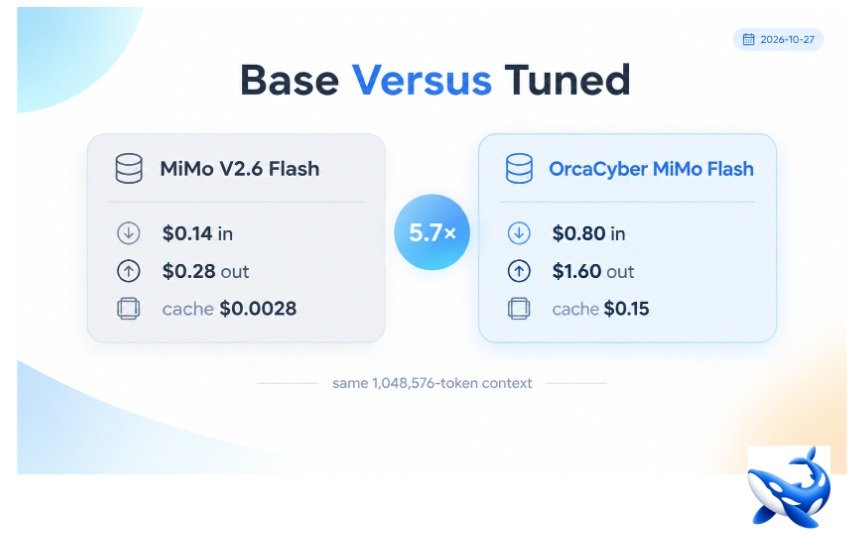
Through OrcaRouter both the base Xiaomi model and the tuned build sit on one key, which makes the MiMo V2.6 Flash abliterated pricing a clean comparison rather than a cross-vendor one. The tuned card is $0.80 in and $1.60 out per million; the base is $0.14 and $0.28 [OURS]. That is 5.71× on both sides — the rare case where the input and output multiples are identical.
That symmetry makes the arithmetic easy. It also hides where the real cost difference comes from.
The table
| Line | Base MiMo V2.6 Flash | OrcaCyber MiMo Flash | Multiple |
| Input / M | $0.14 | $0.80 | 5.71× |
| Output / M | $0.28 | $1.60 | 5.71× |
| Cache read / M | $0.0028 | $0.15 | 53.6× |
| Context | 1,048,576 | 1,048,576 | same |
| Output ceiling | 131,072 | 131,072 | same |
| Modalities in | text, image | text, image, audio, video | +2 |
The first two rows are the headline. The third is the one that surprises people, and the last is the reason anyone would pay twice over.
The cache line is 53 times worse
A cache read on the base costs $0.0028 per million; on the tuned card it costs $0.15 [OURS]. That is a 53.6× gap, an order of magnitude wider than the headline multiple.
On an agent loop with a hot prefix, this dominates. A million-token prefix at ninety percent cache hits costs:
- Base: 0.1 × $0.14 + 0.9 × $0.0028 = $0.0165 per million
- Tuned: 0.1 × $0.80 + 0.9 × $0.15 = $0.215 per million
A 13× gap on the workload that most agent architectures actually run [OURS]. The headline multiple is 5.71×; the cache-adjusted multiple is more than twice that.
If your pipeline reuses a large system prompt on every call, budget from the second number, not the first.
What the extra modalities are worth
The tuned card adds audio and video input. The base takes text and images only.
Whether that is worth 5.71× is a question about your intake, not about the model. If evidence arrives as recordings and screen captures, the base card cannot do the job at any price and the comparison is moot. If your evidence is text and screenshots, you are paying for modalities you will never use.
There is no middle case here. That is worth saying because “multimodal” is often presented as a gradual improvement rather than a binary capability.
Cost per artifact
Take the audit-shaped request: 200,000 input tokens, 20,000 output.
- Base: 0.2 × $0.14 + 0.02 × $0.28 = $0.034
- Tuned: 0.2 × $0.80 + 0.02 × $1.60 = $0.192
A hundred audits a month is $3.36 against $19.20 [OURS]. Sixteen dollars is not a budget decision; it is a rounding error in an engineering week.
At ten thousand audits a month the same comparison is $336 against $1,920, and the conversation changes shape — though at that volume the cache ratio matters more than the headline rate, and the real gap is larger than these figures suggest.
What you are paying for
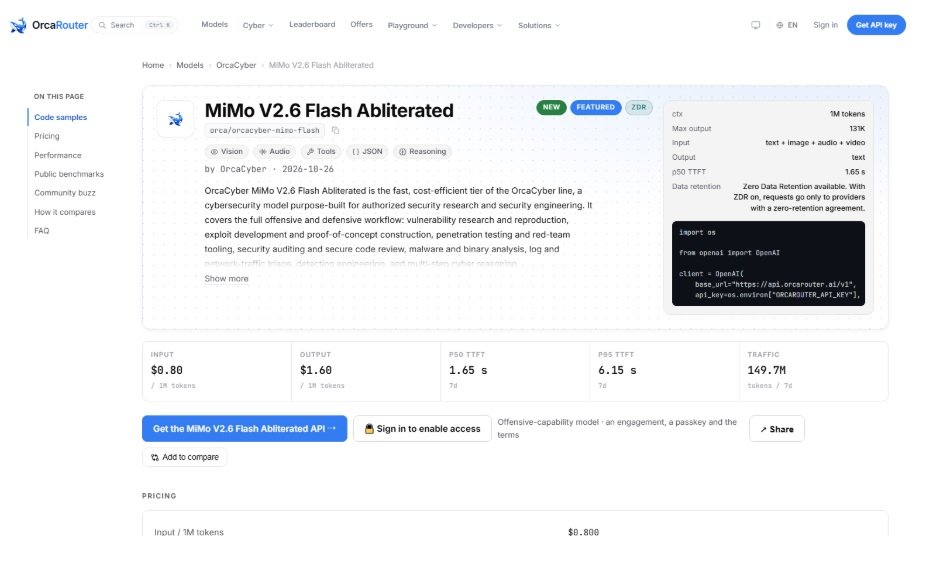
Three things, in order of how much they matter.
The tuning. Refusal behaviour removed, which is the entire point.
The modalities. Audio and video on a security-tuned model is a narrow capability; if you need it, it is hard to substitute.
The operations. Somebody else runs the endpoint, and the rate includes that.
What you are not paying for is a better model. The benchmarks for the tuned card are its own; the base has no comparable public rows in our catalogue, and the price gap is not a claim about quality.
When the base is the right answer
Two cases, both common.
Your prompts are never refused. Then the tuning buys nothing and the base is five point seven times cheaper for identical output.
Your evidence is text and images. Then audio and video are dead weight, and the base card carries the same context window and the same ceiling at a fifth of the rate.
The honest test is the same as everywhere else in this series: sample your traffic, count refusals, and check whether any input is a recording. Two of those three answers decide it before price enters the conversation.
A routing policy that uses both
Because the two cards share a key and differ by a factor of 5.71, a routing policy is cheap to build and usually pays for itself in a week.
Three rules cover most traffic:
Media present? Route to the tuned card. The base cannot accept audio or video at all, so this is not a price decision.
Refusal returned? Retry once on the tuned card. The retry costs five point seven times the original call and saves the request.
Everything else? Stay on the base. This is the bulk of the traffic and the bulk of the saving.
Log which rule fired. A month of that log tells you the true refusal rate, which is the number every other decision in this series depends on — and it is measured on your traffic rather than on a benchmark.
There is one trap in the policy. A retry that fires on every request because the first request always fails is not a routing rule; it is a doubling of the bill. Watch the ratio of rule-two fires to total requests. If it is above ten percent, something is wrong with the base path, not with the model choice.
What you would need for the tuned card to pay for itself everywhere
A single-card policy is simpler than a routing policy, and it is worth asking what would justify it.
The answer is a refusal rate high enough that the retry branch dominates. Above roughly half of traffic, the routing rule has stopped being an optimisation and become the main path — at which point running everything on the tuned card costs less in engineering than it saves in tokens.
Below that, the split is worth maintaining. It is five lines of logic and a log line.
The takeaway
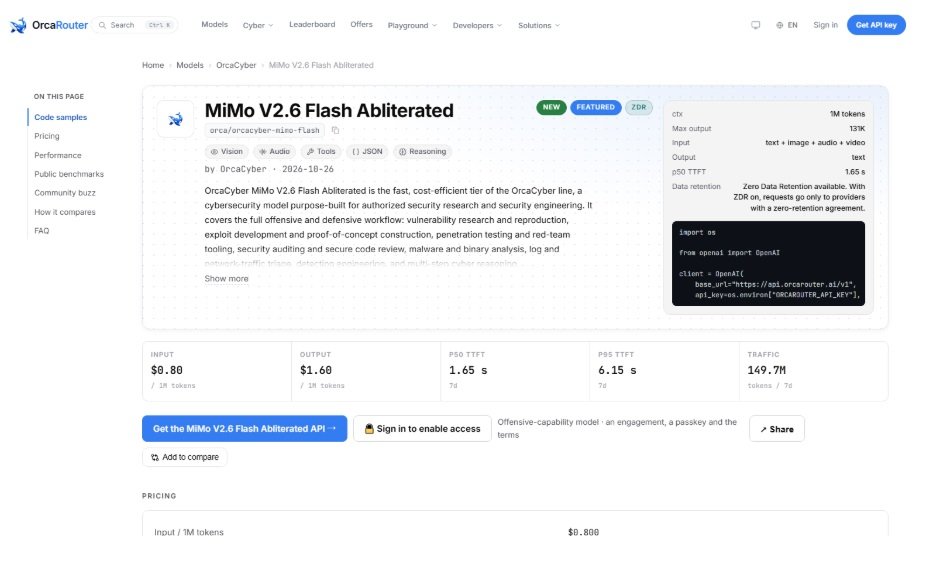
Five point seven one times on both input and output, a cache line that is fifty-three times worse, and two extra modalities. The headline multiple understates the real cost on cache-heavy workloads by more than double.
Pay it if you need the tuning and the audio and video paths. Skip it if you need neither — the context window and ceiling are identical, so nothing is lost by staying on the base.
The comparison is also a reminder that headline multiples are the least informative part of any price sheet. The ratio that decides a bill is the one on the line your workload actually spends its tokens on, and for agent work that is almost never the number in the marketing.
Sourcing note: all rates, context windows, ceilings and modalities are OrcaRouter catalogue data, checked 2026-10-27 [OURS]. Per-artifact and cache figures are arithmetic on those rates at the stated token counts and hit rates. No latency, throughput or benchmark figures are used in this article.