Mashable Connections Hint Today: The Complete Daily Guide
Finding the right strategy to solve the daily puzzle is why many players rely on a Mashable Connections Hint Today: The Complete Daily Guide. This resource provides the necessary clues to help you group sixteen words into four distinct categories without losing your streak.
By understanding how the game functions and learning how to interpret the provided hints, you can consistently solve the grid. This article serves as your primary reference for mastering the game and ensuring you never get stuck on a tricky set of terms again.
Understanding the Basics of Connections
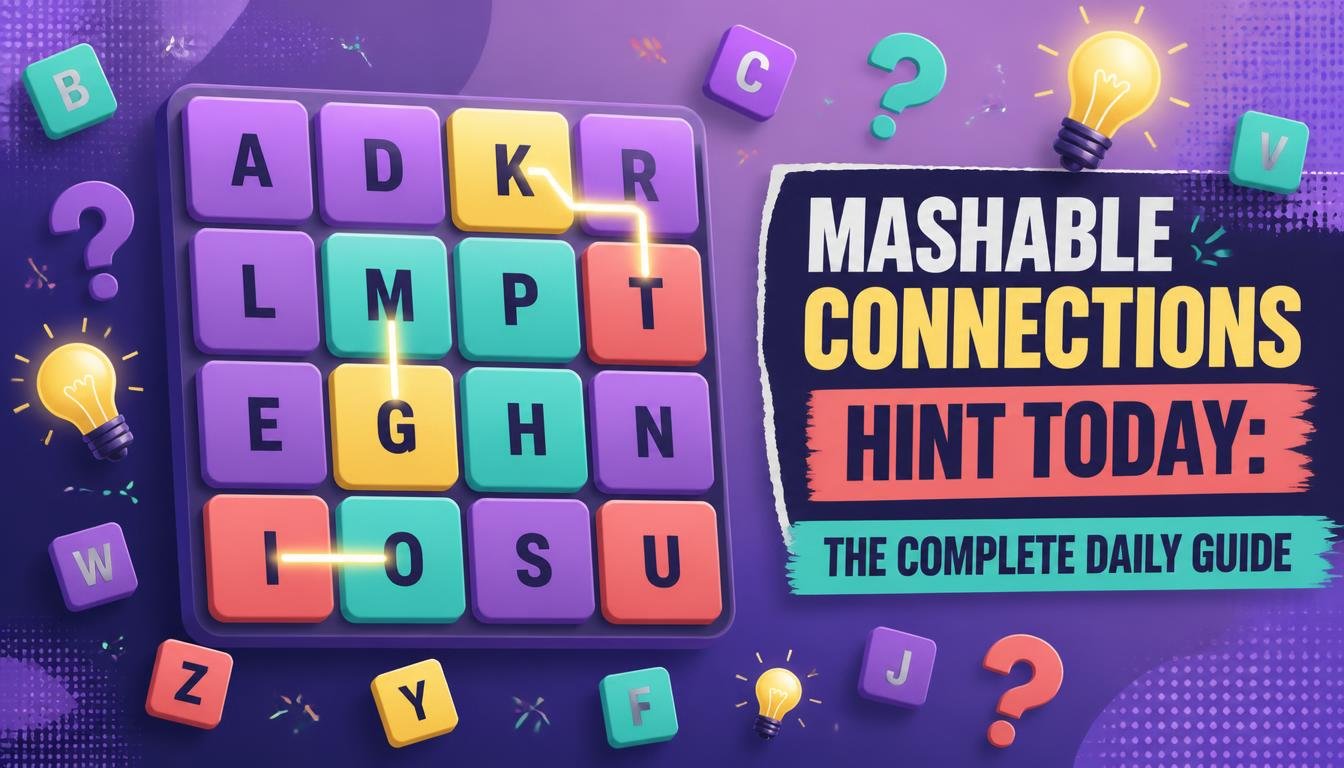
The game is a daily challenge presented by the New York Times that tests your ability to categorize words based on hidden relationships. Each board contains sixteen tiles that must be sorted into four groups of four.
These groups are color-coded by difficulty, ranging from yellow (the easiest) to purple (the most abstract or pun-heavy). You are given four mistakes before the game ends, so precision is essential.
Many players find that the initial view of the board is intentionally misleading. You will often see words that seem to belong to multiple categories, which is a classic design feature meant to trap you.
The key is to look for synonyms, compound words, or shared prefixes that aren’t immediately obvious. Once you identify one group, the remaining tiles become much easier to parse.
How to Use Daily Hints Effectively
When you consult a Mashable Connections Hint Today: The Complete Daily Guide, you are essentially looking for a nudge in the right direction rather than a direct answer. Start by reading the descriptions of the four categories without looking at the specific words included in them.
This allows your brain to form its own associations before you see the solution. If you still feel stuck, look at the first word provided for each category.
Using hints effectively means knowing when to stop looking. If a hint reveals one of the categories but you still need to figure out which four words fit, try to isolate those words on your own first.
This practice improves your pattern recognition skills over time. Over-reliance on the answers can diminish the satisfaction of solving the puzzle, so try to use the clues as a ladder rather than an elevator.
The Logic Behind the Categories
The categories in the game are rarely straightforward definitions. They often rely on wordplay, such as “Words that end in a specific sound” or “Things you can do with a piece of paper.”
Sometimes, the categories are based on pop culture references or specific types of objects that share a functional similarity. You should look for structural patterns in the words themselves, such as their length, parts of speech, or hidden sub-words.
If you find yourself stuck on a group of four, try to step back and look at the board as a whole again. Often, you will notice that one word in your current selection is actually the “distractor” for a different category.
Eliminating the distractor is usually the breakthrough moment for most players. Keep a mental list of the types of groups you have seen in the past to build your intuition.
Common Patterns and Traps
The game designers frequently employ “red herrings” to make specific words look like they belong together. For example, if you see several types of fruit, you might be tempted to group them, but the real category might be “words that are also colors.”
This is why it is vital to read every single word on the board before you make your first move. Do not rush to submit a guess just because you see a possible connection.
Another common trap involves using synonyms that are too broad. If a category is “synonyms for fast,” ensure all four words are equally strong candidates.
If one word feels like a stretch, it probably belongs to a different group entirely. Always look for the tightest possible link between the four items before clicking submit.
See More: Zavalio Com Review 2026: The Creator-First Platform Changing Digital Publishing Forever
Tracking Your Progress Over Time
Maintaining a consistent record of your daily performance can help you identify your strengths and weaknesses. Some players keep a simple log of the categories they find easiest versus those they find most difficult.
You might find that you are excellent at identifying homophones but struggle with categories involving historical figures. Tracking these details helps you adjust your focus when you approach a new board.
Consistency is the hallmark of a great player. By engaging with the daily puzzle, you are training your brain to switch between different types of linguistic logic. You can use the following table to organize how you approach the difficulty levels each day:
| Difficulty Level | Common Characteristics | Strategy |
|---|---|---|
| Yellow | Straightforward synonyms | Look for direct definitions |
| Green | Shared prefixes or suffixes | Check the word structure |
| Blue | Categorical associations | Identify the common theme |
| Purple | Wordplay and puns | Think outside the dictionary |
Building a Daily Solving Routine
To become a master at the game, you should establish a ritual that clears your mind before you start. Many successful players find that solving the puzzle at the same time each day helps them get into the right frame of mind.
You might want to grab a coffee or take a short walk to reset your focus. A calm, analytical approach is almost always more effective than a hurried, guessing-based one.
When you start, read the words aloud to yourself. Hearing the words can sometimes trigger a connection that your eyes might miss when just scanning the grid.
If you are struggling, walk away from the screen for ten minutes. The “incubation effect” is real; your brain will often continue to process the information in the background while you focus on something else.
Essential Tips for Tougher Puzzles
* Check for compound words: See if all four words can be preceded or followed by the same word.
* Look for hidden themes: Search for categories like “types of pasta” or “famous fictional detectives.”
* Use the shuffle button: Shuffling the board changes your visual perspective and can break the mental rut of seeing the same groupings.
* Limit your guesses: If you are down to your last guess, spend extra time verifying the remaining groups.
* Review past answers: Even if you solve it perfectly, checking the official explanation later can teach you new ways to think about word relationships.
If you find yourself consistently missing the mark, consider visiting the official New York Times Connections homepage to see how the developers structure their daily challenges. Understanding their logic is the best way to improve your own results over time.
Frequently Asked Questions
How often do the categories reset?
The puzzle resets every single day at midnight in your local time zone. This means you have a fresh board to solve every morning, providing a consistent way to practice your skills.
What should I do if I run out of guesses?
If you exhaust your four allowed mistakes, the game will reveal the final categories for you. Don’t feel discouraged; treat it as a learning opportunity to see how the words were meant to be grouped.
Are there specific days that are harder than others?
While the difficulty is somewhat subjective, many players report that the puzzles on weekends, particularly Sundays, tend to be more abstract or challenging. It is best to approach every day with the same level of focus.
Can I play older puzzles?
The standard interface typically only allows access to the current day’s puzzle. Some users archive them, but the core experience is designed around the daily, communal challenge.
Is it cheating to look at hints?
Using a guide is a personal choice, and many people use them to learn the logic behind the game. As long as you are using the information to improve your own ability to solve future grids, it is a productive way to play.
Conclusion
Mastering the daily puzzle is a rewarding way to sharpen your linguistic skills and keep your mind engaged. By relying on a Mashable Connections Hint Today: The Complete Daily Guide, you gain the perspective needed to untangle even the most complex grids. Remember that every mistake is simply a lesson in how the game’s creators think, which will make you a faster and more accurate player in the long run.
Keep practicing, stay patient with your progress, and enjoy the process of connecting the dots each day. Whether you are playing for fun or to beat your personal best, taking the time to analyze the relationships between words is a fantastic mental exercise. We hope this guide helps you feel more confident as you tackle your next set of words.